
Sustainability is a frequently used word. It is considered as something new, but actually it is not new. The word might have emerged in our world, but sustainability practices are routine. It is phenomenal when every action is taken with responsibility. Doing things that are socio-economic and environmentally responsible refers to sustainability. Then wither it is an individual action of collective, industrial, or market oriented.
However, there is still a need to understand what sustainability is. In real it is a motivation, wisdom, or discipline. Performing each work within the paradigm of sustainability needs these two contexts, socio-economic and environmental. In policy documents, corporate reports, academic research, climate activism, and everyday conversations, sustainability is considered a core pillar. Therefore, in the current era, it has received tremendous popularity.
Yet despite its popularity, sustainability is often poorly understood. Various questions arise in the mind when dealing with sustainability. Is it merely a technical framework? Is it an ethical principle? Or is it a personal mindset that drives responsible behavior and so on?
At its core, sustainability is not just a destination, but it’s a way of thinking and acting. It is related to responsibility and behavior. It sits at the intersection of discipline, wisdom, and motivation. These three lenses provide a comprehensive understanding of sustainability. Even if they allow us to move beyond slogans and toward meaningful and long-term change.
- Understanding Sustainability
Sustainability is commonly defined as meeting the needs of the present without compromising the ability of future generations. Simply, today, responsible actions can save future generations and resources. When actions are in favor of the socio-economic and environmental context, they provide a foundation that captures the depth of the concept.
Balancing the consumption and production is also considered as sustainability. Balance the economic growth and environmental protection, human development at once makes a complete paradigm of sustainability. It applies at multiple levels: individual behavior, community practices, national policies, and global systems. They are all contributors to sustainability within their orbit.
To grasp sustainability in practice, there is a need to explore what, in fact, it is; whether it functions primarily as a discipline, a form of wisdom, or a source of motivation. Let’s discuss the three of them in detail:
1.1 Sustainability as a Discipline
Discipline is a permanent action which might be slow but consistent. From an academic and professional perspective, sustainability is a discipline. It is not a thing that appears haphazardly or for a short period of time. It is evolved from various domains like economics, environmental science, sociology, urban planning, engineering, and political science.
By the time the world understands its importance. At each level, it is being implemented practically or theoretically. Universities now offer degrees in the sustainability studies domain. Similar other programs being offered are sustainable development, environmental economics, and climate policy.
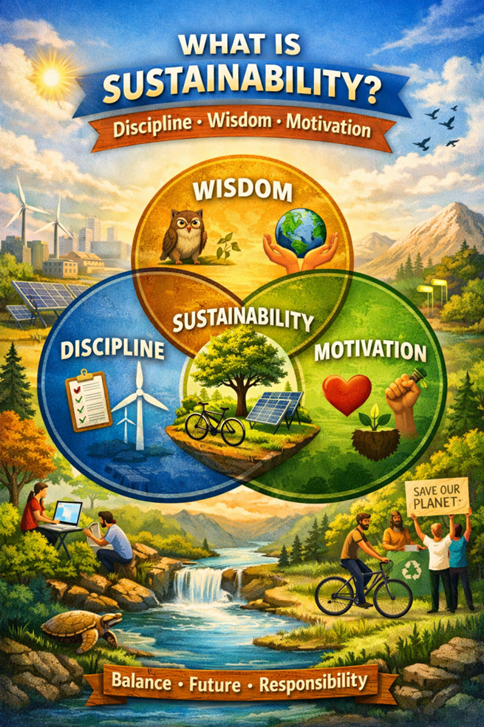
Here, the word discipline serves two contexts; one is academic discipline where sustainability being taught in education institutes. While the other is an action that is being performed through determination, devotion, and enthusiasm. From an academic point of view a discipline of sustainability provides:
- Analytical tools to measure environmental impacts, such as carbon footprints and life-cycle assessments
- Frameworks like the Sustainable Development Goals (SDGs)
- Policies and strategies for climate mitigation, adaptation, and resource management
Here, the role of the Green HUB Initiative is not negligible. Green HUB focuses on sustainability practices that are subject to discipline orientation. As discipline implies structure, consistency, and accountability, it should be accompanied by long-term planning. It requires governments to design policies. These policies aim to integrate environmental limits with social equity. Without discipline, sustainability becomes vague and symbolic. Thus, discipline transforms good intentions into actionable strategies.
1.1.1 Limits of Sustainability as Only a Discipline
However, discipline alone is not enough for sustainable practices. Policies can be well-designed but poorly implemented, as it is being noticed especially in the developing world. Taking into account one of the greatest bottlenecks that sustainability plans can exist on paper, while ecosystems continue to degrade. This gap exists because discipline addresses what should be done, but not always why people should care.
Thus, it is essential to ensure that a purely technical approach does not turn sustainability into a bureaucratic exercise. It should not be a living commitment. That is where wisdom enters.
1.2 Sustainability as Wisdom
Wisdom is the ability to apply knowledge with foresight. It also involves ethics and humility. Sustainability reflects wisdom because it acknowledges limits. These limits can be in the form of: limit to natural resources, limits to growth, and limits to human dominance over nature.
Traditional societies practiced sustainability long before. Indigenous communities understood seasonal cycles. They were close to nature as current societies are close to technology and related products. But they have one key characteristic: they respected ecological boundaries and valued intergenerational responsibility. These characteristics were not guided by modern data models but by accumulated wisdom.
Sustainability as wisdom teaches us:
- Nature is not infinite
- Short-term gains can cause long-term harm
- Human well-being is inseparable from ecological health
Discussing nature is not infinite means human action that causes damage to nature can badly affects it. Sometimes these damages are irreversible or take much more time and efforts to repair it. Like deforestation harm the environment along with rising temperature to massive climate changes. To stop deforestation and move toward afforestation takes much time, investment, effort, and other resources. So here wisdom come and play its role.
Wisdom shifts sustainability from a technical challenge to a moral responsibility. It considers future generations and vulnerable communities. It involves nature oriented scenarios that reframes development in quality of life. It is not an unlimited expansion of human oriented actions but an improvement within planetary boundaries.
1.2.1 Wisdom in Decision-Making
When sustainability is guided by wisdom, decisions change. Wisdom prioritizes the thoughts and actions for future generations. For example:
- Cities prioritize public transport and green spaces over car-centered expansion
- Farmers adopt regenerative practices instead of extractive agriculture
- Policymakers consider long-term climate risks rather than short electoral cycles
The Green HUB is a strong believer in sustainability and sustainable practices. It leads to sustainability as wisdom and intellectual actions, which encourage long-term thinking. It focuses on those qualities often missing in modern economic systems. It changes the way of thinking. It molds actions from irresponsible to responsible. It reminds us that progress without sustainability is ultimately self-defeating.
1.3 Sustainability as Motivation
Sustainability as a discipline and wisdom keeps its distinct position. While discipline provides structure, wisdom offers direction. Besides, both of them provide motivation and energy. Thus, sustainability requires action, and action depends on motivation.
People are involved in various sustainable practices. They range from recycling, conserve water, reducing waste, and advocating for climate justice. These are not compulsion but because it provides feels related to responsibility, connection, or hopefulness. Motivation transforms sustainability from an obligation into a personal commitment.
There is a general concept that motivation is temporary while discipline is permanent. However, to make an action a discipline, there is a need for motivation. Therefore, sustainability as motivation covers multiple contexts, like:
- Awareness of environmental crises
- Emotional connection to nature
- Concern for children and future generations
- Desire for healthier and more equitable societies
Thus, it is suitable to say that motivation is what turns knowledge into behavior. Without it, sustainability remains abstract. The Green HUB also emphasize on sustainability as a motivation. We work on sustainable cities and green cover. We perform our work in accordance with the Sustainable Development Goals. We work in the wake of a clean, fresh, and responsible planet.
1.3.1 The Role of Motivation in Social Change
Major sustainability movements are driven by motivated individuals and communities. They involve climate activism, zero-waste lifestyles, and renewable energy transitions. All of them are participatory factors of the sustainability movement. Among these, motivation fuels innovation and cultural change.
However, motivation alone is unfavorable and undesirable. Its benefits can be eroded by the time being when it fails to deliver strong support systems, no incentives, and ineffective institutional backing. This is why sustainability cannot rely solely on individual motivation; it must be reinforced by discipline and guided by wisdom.
1.4 The Interconnection: Discipline, Wisdom, and Motivation
Sustainability works better and becomes more effective when these three elements work together:
- Discipline ensures consistency, measurement, and accountability
- Wisdom ensures ethical grounding and long-term vision
- Motivation ensures participation, creativity, and momentum
Remove any one element, and sustainability weakens. Discipline without wisdom becomes rigid. Wisdom without motivation remains passive. Motivation without discipline becomes scattered and short-lived.
True sustainability emerges when systems, values, and actions are aligned.
1.4.1 Sustainability in Everyday Life
Sustainability is not limited to global summits. It begins with everyday choices for households, families, businesses, and the state:
- Choosing durable products over disposable ones
- Reducing food waste
- Supporting local and sustainable businesses
- Using energy and water responsibly
These actions reflect discipline (habit formation), wisdom (understanding consequences), and motivation (personal responsibility). So it is easy to say that sustainability is not merely an action but a combo of three pillars: discipline, wisdom, and motivation. Therefore, when sustainability is internalized, it moves from being an external requirement to an internal value.
1.5 Challenges in Practicing Sustainability
Every stakeholder practicing sustainability is subject to numerous challenges, such as:
- Short-term economic priorities
- Political resistance
- Inequality and lack of resources
- Misinformation and climate skepticism
Addressing these challenges requires systemic change. The change is supported by a number of actors, like informed citizens, ethical leadership, and motivated communities.
1.5.1 The Way Forward
The future of sustainability depends on how we define and practice it. It is a long-term, consistent, and gradual process. It must be accompanied by discipline, wisdom, and motivation.
Sustainability should be integrated at every level. Like education systems should integrate sustainability across subjects. Governments must design policies that reward long-term thinking. Communities should foster cultures of responsibility and care. Individuals must recognize their role. All of them are player and can play their significant role.
Sustainability is not a sacrifice; rather, it is an investment in resilience, equity, and survival.
1.6 Conclusion
So, what is sustainability: discipline, wisdom, or motivation?
The answer is all three.
Sustainability is a discipline that structures action. Sustainability as a wisdom guides decisions. Sustainability as a motivation drives change. It is both a science and a philosophy. Both of them are based on a policy framework and a personal ethic.
Leave a Reply