Green HUB Initiative–A sustainability Organization
  • About Us
  • What is nbs?
  • Our Blogs
  • SLS Portfolio
  • More
    • Team
    • Forms
  • Instagram
  • Facebook
  • X
  • What Is Sustainability: Discipline, Wisdom, or Motivation?

    Sustainability is a frequently used word. It is considered as something new, but actually it is not new. The word might have emerged in our world, but sustainability practices are routine. It is phenomenal when every action is taken with responsibility. Doing things that are socio-economic and environmentally responsible refers to sustainability.  Then wither it is an individual action of collective, industrial, or market oriented.

    However, there is still a need to understand what sustainability is. In real it is a motivation, wisdom, or discipline. Performing each work within the paradigm of sustainability needs these two contexts, socio-economic and environmental. In policy documents, corporate reports, academic research, climate activism, and everyday conversations, sustainability is considered a core pillar. Therefore, in the current era, it has received tremendous popularity.

    Yet despite its popularity, sustainability is often poorly understood. Various questions arise in the mind when dealing with sustainability. Is it merely a technical framework? Is it an ethical principle? Or is it a personal mindset that drives responsible behavior and so on?

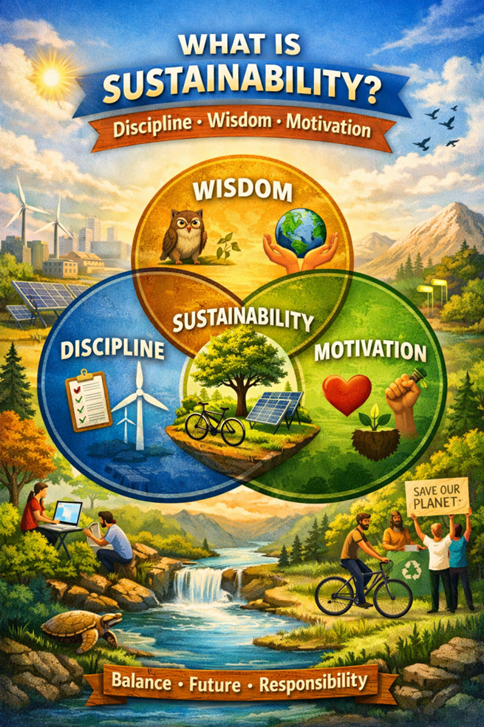
    At its core, sustainability is not just a destination, but it’s a way of thinking and acting. It is related to responsibility and behavior. It sits at the intersection of discipline, wisdom, and motivation. These three lenses provide a comprehensive understanding of sustainability. Even if they allow us to move beyond slogans and toward meaningful and long-term change.

    1. Understanding Sustainability

    Sustainability is commonly defined as meeting the needs of the present without compromising the ability of future generations. Simply, today, responsible actions can save future generations and resources. When actions are in favor of the socio-economic and environmental context, they provide a foundation that captures the depth of the concept.

    Balancing the consumption and production is also considered as sustainability.  Balance the economic growth and environmental protection, human development at once makes a complete paradigm of sustainability. It applies at multiple levels: individual behavior, community practices, national policies, and global systems. They are all contributors to sustainability within their orbit.

    To grasp sustainability in practice, there is a need to explore what, in fact, it is; whether it functions primarily as a discipline, a form of wisdom, or a source of motivation. Let’s discuss the three of them in detail:

    1.1 Sustainability as a Discipline

    Discipline is a permanent action which might be slow but consistent. From an academic and professional perspective, sustainability is a discipline. It is not a thing that appears haphazardly or for a short period of time. It is evolved from various domains like economics, environmental science, sociology, urban planning, engineering, and political science.

    By the time the world understands its importance. At each level, it is being implemented practically or theoretically. Universities now offer degrees in the sustainability studies domain. Similar other programs being offered are sustainable development, environmental economics, and climate policy.

    Acknowledgement: This is AI generated image

    Here, the word discipline serves two contexts; one is academic discipline where sustainability being taught in education institutes. While the other is an action that is being performed through determination, devotion, and enthusiasm. From an academic point of view a discipline of sustainability provides:

    • Analytical tools to measure environmental impacts, such as carbon footprints and life-cycle assessments
    • Frameworks like the Sustainable Development Goals (SDGs)
    • Policies and strategies for climate mitigation, adaptation, and resource management

    Here, the role of the Green HUB Initiative is not negligible. Green HUB focuses on sustainability practices that are subject to discipline orientation. As discipline implies structure, consistency, and accountability, it should be accompanied by long-term planning. It requires governments to design policies. These policies aim to integrate environmental limits with social equity. Without discipline, sustainability becomes vague and symbolic. Thus, discipline transforms good intentions into actionable strategies.

    1.1.1 Limits of Sustainability as Only a Discipline

    However, discipline alone is not enough for sustainable practices. Policies can be well-designed but poorly implemented, as it is being noticed especially in the developing world. Taking into account one of the greatest bottlenecks that sustainability plans can exist on paper, while ecosystems continue to degrade. This gap exists because discipline addresses what should be done, but not always why people should care.

    Thus, it is essential to ensure that a purely technical approach does not turn sustainability into a bureaucratic exercise. It should not be a living commitment. That is where wisdom enters.

    1.2 Sustainability as Wisdom

    Wisdom is the ability to apply knowledge with foresight. It also involves ethics and humility. Sustainability reflects wisdom because it acknowledges limits. These limits can be in the form of: limit to natural resources, limits to growth, and limits to human dominance over nature.

    Traditional societies practiced sustainability long before. Indigenous communities understood seasonal cycles. They were close to nature as current societies are close to technology and related products. But they have one key characteristic: they respected ecological boundaries and valued intergenerational responsibility. These characteristics were not guided by modern data models but by accumulated wisdom.

    Sustainability as wisdom teaches us:

    • Nature is not infinite
    • Short-term gains can cause long-term harm
    • Human well-being is inseparable from ecological health

    Discussing nature is not infinite means human action that causes damage to nature can badly affects it. Sometimes these damages are irreversible or take much more time and efforts to repair it. Like deforestation harm the environment along with rising temperature to massive climate changes. To stop deforestation and move toward afforestation takes much time, investment, effort, and other resources. So here wisdom come and play its role.

    Wisdom shifts sustainability from a technical challenge to a moral responsibility. It considers future generations and vulnerable communities. It involves nature oriented scenarios that reframes development in quality of life. It is not an unlimited expansion of human oriented actions but an improvement within planetary boundaries.

    1.2.1 Wisdom in Decision-Making

    When sustainability is guided by wisdom, decisions change. Wisdom prioritizes the thoughts and actions for future generations. For example:

    • Cities prioritize public transport and green spaces over car-centered expansion
    • Farmers adopt regenerative practices instead of extractive agriculture
    • Policymakers consider long-term climate risks rather than short electoral cycles

    The Green HUB is a strong believer in sustainability and sustainable practices. It leads to sustainability as wisdom and intellectual actions, which encourage long-term thinking. It focuses on those qualities often missing in modern economic systems. It changes the way of thinking. It molds actions from irresponsible to responsible. It reminds us that progress without sustainability is ultimately self-defeating.

    1.3 Sustainability as Motivation

    Sustainability as a discipline and wisdom keeps its distinct position. While discipline provides structure, wisdom offers direction. Besides, both of them provide motivation and energy. Thus, sustainability requires action, and action depends on motivation.

    People are involved in various sustainable practices. They range from recycling, conserve water, reducing waste, and advocating for climate justice. These are not compulsion but because it provides feels related to responsibility, connection, or hopefulness. Motivation transforms sustainability from an obligation into a personal commitment.

    There is a general concept that motivation is temporary while discipline is permanent. However, to make an action a discipline, there is a need for motivation. Therefore, sustainability as motivation covers multiple contexts, like:

    • Awareness of environmental crises
    • Emotional connection to nature
    • Concern for children and future generations
    • Desire for healthier and more equitable societies

    Thus, it is suitable to say that motivation is what turns knowledge into behavior. Without it, sustainability remains abstract. The Green HUB also emphasize on sustainability as a motivation. We work on sustainable cities and green cover. We perform our work in accordance with the Sustainable Development Goals. We work in the wake of a clean, fresh, and responsible planet.

    1.3.1 The Role of Motivation in Social Change

    Major sustainability movements are driven by motivated individuals and communities. They involve climate activism, zero-waste lifestyles, and renewable energy transitions. All of them are participatory factors of the sustainability movement. Among these, motivation fuels innovation and cultural change.

    However, motivation alone is unfavorable and undesirable. Its benefits can be eroded by the time being when it fails to deliver strong support systems, no incentives, and ineffective institutional backing. This is why sustainability cannot rely solely on individual motivation; it must be reinforced by discipline and guided by wisdom.

    1.4 The Interconnection: Discipline, Wisdom, and Motivation

    Sustainability works better and becomes more effective when these three elements work together:

    • Discipline ensures consistency, measurement, and accountability
    • Wisdom ensures ethical grounding and long-term vision
    • Motivation ensures participation, creativity, and momentum

    Remove any one element, and sustainability weakens. Discipline without wisdom becomes rigid. Wisdom without motivation remains passive. Motivation without discipline becomes scattered and short-lived.

    True sustainability emerges when systems, values, and actions are aligned.

    1.4.1 Sustainability in Everyday Life

    Sustainability is not limited to global summits. It begins with everyday choices for households, families, businesses, and the state:

    • Choosing durable products over disposable ones
    • Reducing food waste
    • Supporting local and sustainable businesses
    • Using energy and water responsibly

    These actions reflect discipline (habit formation), wisdom (understanding consequences), and motivation (personal responsibility). So it is easy to say that sustainability is not merely an action but a combo of three pillars: discipline, wisdom, and motivation. Therefore, when sustainability is internalized, it moves from being an external requirement to an internal value.

    1.5 Challenges in Practicing Sustainability

    Every stakeholder practicing sustainability is subject to numerous challenges, such as:

    • Short-term economic priorities
    • Political resistance
    • Inequality and lack of resources
    • Misinformation and climate skepticism

    Addressing these challenges requires systemic change. The change is supported by a number of actors, like informed citizens, ethical leadership, and motivated communities.

    1.5.1 The Way Forward

    The future of sustainability depends on how we define and practice it. It is a long-term, consistent, and gradual process. It must be accompanied by discipline, wisdom, and motivation.

    Sustainability should be integrated at every level. Like education systems should integrate sustainability across subjects. Governments must design policies that reward long-term thinking. Communities should foster cultures of responsibility and care. Individuals must recognize their role. All of them are player and can play their significant role.

    Sustainability is not a sacrifice; rather, it is an investment in resilience, equity, and survival.

    1.6 Conclusion

    So, what is sustainability: discipline, wisdom, or motivation?

    The answer is all three.

    Sustainability is a discipline that structures action. Sustainability as a wisdom guides decisions. Sustainability as a motivation drives change. It is both a science and a philosophy. Both of them are based on a policy framework and a personal ethic.

    March 7, 2026
  • Protecting nature is not a cost; it is an investment-Ghana Shea trees example

    Ghana is a West African country rich in Shea trees. It produces export-quality Shea butter and nuts. A bundle of daily-use items can also be produced from the Shea tree, like edible oil, cosmetics, hair conditioner, soap, and medicine. This tree accounts for a significant portion of the economy and supports the livelihood of the people.

    In order to protect these Shea trees, Ghana has designed a new strategy via reversing the deforestation.  Around one hundred thousand people (100,000) are employed for the protection of these trees. Mostly, indigenous people were hired. To protect them from natural hazards and pest attacks, special measures have been taken. These include pest spray, anti-fire chemicals, and other relevant measures.

    These trees not only contribute in local economy but also play their role in the environment. They could save 25 million tons of CO2 emissions by 2040. But all depends upon the successful accomplishment of this new strategy. Failing to do so can cost a lot. The local administration is restoring 100,000 hectares of Shea parkland and 200,000 hectares of savanna forests. These plants have the capability to grow in hot and seasonally dry climatic conditions.

    About 25,500 hectares of new forests are under progress. This will contribute more to the economy and the environment. The important thing to note is that local communities are being involved in monitoring and managing this huge project. This project will provide work to 100,000 people (as discussed above). Already 8 million local women are linked to Shea tree related daily work. In the last 20 years, the global demand for Shea products has risen 600%. According to the Global Shea Alliance, approximately 8 million trees are lost annually. They were subject to climate change and poor farming. Reversing this trend will achieve the milestone, not only protect Shea tress but save the livelihood of local communities.

    What is new strategy to protect planet? ‘

    Every country is taking it seriously, too, for trees. These trees are nature-based sustainability solutions. They are a source of economic benefits and contribute to the environment. Trees bring down the temperature, add beauty, and provide shelter. All those things having socio-economic and environmental benefits are sustainable.

    Sustainability is the other name of the fashion that persists for a longer time period without harming society, the economy, and the environment (SEE). It can be from trees to technology, from waste to cosmetics, and raw to valuable. So anyone exercising any of the business activity in pursuit of above given 3 benefits (SEE) comes in the domain of sustainability. He/she might be a sustainability professional, a sustainability adult, or a sustainability student. All it needs is to learn and understand what sustainability is.

    Shea Trees as a Model for Nature-Based Solutions (NBS)

    As discussed above, the case of Shea tree conservation in Ghana is an excellent example of Nature-Based Solutions (NBS). It addresses environmental degradation, climate change, and socioeconomic vulnerability simultaneously. It is often considered a conventional development projects which paysoff short-term gains. However, NBS emphasizes long-term resilience. It is a mechanism where working goes with nature rather than against it. Shea trees have the potential to transform the African economic and environmental scenario. It can upgrade landscapes, enhance soil fertility, reduce desertification, and strengthen food and income security for rural households.

    The inclusive development approach can make Shea conservation more powerful. Already, women and indigenous communities are being involved. It is highly appreciated as this become source of earning and a culture where every individual take its part. These trees are a livelihood opportunity rather than a restriction. This approach is community-centered governance. It can increase accountability, reduce illegal logging, and ensure that environmental protection aligns with local economic interests.

    Climate Change Mitigation and Adaptation Benefits

    Thinking this into a longer perspective, the Shea trees contribute to both climate mitigation and climate adaptation. Both are environmentally beneficial. On the mitigation side, their ability to sequester carbon helps reduce greenhouse gas concentrations. It is in the huge interest of the economy as it supports national and global climate targets. On the adaptation side, Shea trees are highly resilient to drought and high temperatures. This strength makes them suitable for climate-stressed regions of the Sahel and savanna zones.

    However, by the time being, the climate variability intensified. Countries that invest in climate-resilient species like Shea trees can reduce this vulnerability. These can be in the form of food insecurity, rural poverty, and forced migration. In facts, this demonstrates that climate action does not come at the expense of economic development, but in fact, it can drive it.

    Global Demand, Market Opportunities, and Value Chains

    Discussing the global demand for Shea products opens new horizons of thinking. The rapid growth in global demand for Shea products reflects a broader shift toward ethical consumption, natural cosmetics, and sustainable sourcing. A number of international industries, especially cosmetics, pharmaceuticals, and food processing, are concerned about these products. They are seeking traceable and sustainably harvested raw materials. These products have market value, and they can create a strong incentive for producer countries to invest in sustainable Shea value chains.

    Here, the role of one renowned organization is undeniable. Organizations such as Global Shea Alliance play a crucial role by linking producers to global markets. This alliance not only promotes fair trade standards but also supports policy advocacy. It strengthens local processing capacity rather than exporting raw nuts. Therefore, it can significantly participate in market opportunities like increasing value addition, export earnings, and employment at the community level.

    Lessons for Other Countries

    There is a hidden lesson that other countries can take. This is especially fruitful for the developing and climate-vulnerable countries:

    • Policy integration: Environmental protection should be embedded in national development and employment strategies.
    • Community ownership: Conservation efforts are more effective when local populations see direct economic benefits.
    • Gender inclusion: Empowering women enhances household welfare and strengthens sustainable resource management.
    • Long-term vision: Tree-based solutions require patience but deliver durable economic and ecological returns.

    Countries with similar agro-ecological conditions can replicate this approach. They can also use indigenous tree species in their local environments.

    Sustainability Beyond Trees

    Sustainability is multidimensional where trees are one of its participants. Considering that trees remain central to sustainability. This concept extends far beyond forestry. Sustainable practices include a number of dimensions. They are renewable energy adoption, circular economy models, and waste-to-resource innovations. They also include green finance and digital solutions that reduce environmental footprints. What unites all these approaches is their alignment with social equity, economic viability, and environmental integrity.

    Sustainability is not limited to governments or large corporations. It starts from the household level, small businesses, students, and professionals all play a role.

    Concluding Perspective

    The Shea tree initiative highlights a fundamental truth: protecting nature is not a cost, it is an investment. When environmental strategies are designed thoughtfully, they generate employment and empower marginalized groups. This does not remain in this paradigm but also stabilize ecosystems and strengthen economies.

    February 20, 2026
  • From One Home to One Trillion Trees: How 1t.org Is Transforming Nature-Based Solutions

    Growing 3.6 billion plus trees in 60 countries is the commitment of 30 international companies. The loss of nature costs the world about $44 trillion. Along with these 30 companies, all other international stakeholders have set their target to grow, conserve, and restore 1 trillion trees by 2030, named 1t.org.

    1t.org is playing its significant role in nature-based solutions (NBS) of sustainability. It is a necessity of time to combat climate change and the rising global temperature. Achieving this target might be difficult, but it has longer-term effects. The implementation may take longer than expected, but once done successfully, it may contribute positively in the universe. It reducing global temperature, control climate change, protect biodiversity, puts fruitful effects on human life, and reduces cost bearded by economies due to catastrophic events. But the question is, who will do it?

    Who’s responsibility?

    It is neither the state’s responsibility nor the corporate and small business but households should also take their part to make this program successful and timely. For example, take the example at the corporate level, Nestle has committed to plant 200 million trees in and around farm through its company sources. AstraZeneca is committed to planting 50 million trees globally by 2025. 1t.org US Chapter has set a sequence of plantation activities to plant over 50 billion trees under 70 organizations, NGOs, states, and cities. China does not remain behind in this race. It aims to plant and conserve 70 billion trees by 2030.

    Me as a household in NBS

    I am Dr. Umar Suffian Ahmad, Ph.D. in Economics. I am fond of greenery and green cover. I like tree plantation in urban areas, named urban forestry. For the years I was doing this practice at my home. Then I thought to expand my hobby at the city level. I started urban forestation with my family and friends. At that time, I (as a household) was one of contributor in nature-based solutions (NBS) of sustainability.  People start appraising me and start demanding to gift us plants. I was encouraged by the people.

    I never decided to make it an organization or society, but one day sitting with my family, I got suggestion to give this a name. Then I start thinking what the name should be. We just have the idea of urban forestation having the first capital word ‘U’. No other idea, I was silent for weeks, having no other name in mind. After three and a half month I got another idea, why not work for biodiversity (like birds rehabilitation etc). Then I got another first capital letter ‘B’. So I have only two words, ‘U’ & ‘B’. I was silent again for the organization name, but my urban forestation was going on.

    When collecting two words, U & B, I was looking for other words, and then finally reached the decision to make it HUB. What HUB? Then I made it HUB Initiative. But I felt it was incomplete, so after some time, I gave it the name Green HUB Initiative.

    The Green HUB Initiative also participating…

    Green HUB Initiative in the earlier stage has a mission statement: ‘Turn our homes and cities into a jungle’. In the pursuit of this mission, we used to arrange events in institutes, parks, sidewalks of highway and secure places. We involve communities when planting trees. The GLFX forum is most suitable for us to ensure our mission runs more smoothly and effectively. The aim of 1t.org is to protect the planet and make it green.

    The change I would like to bring is that the area we belongs has a harsh and tough environment. The temperature in peak season, June-August remain 48 C’ average. We are struggling and will try our best to create an environment resilient forestation with the help of the local community. So, making it more concerned, the value addition through the Green HUB forum will be environmentally resilient forestation and involving local communities to conserve the forests.

    February 17, 2026
  • Making Earth a Paradise: A Barber’s Wisdom on Sustainability and Life

    A few days ago, I went to a hair salon and sat for a while for my turn. I was quite and barber was busy in haircut of the other customer. In the meantime, the barber was free from the client. He called me to sit on the salon chair. I stepped forward and took the seat. He started haircut, we were both calm and silent. Then after few he started talking to me.

    He shared his thought that all things happening in the world are routine acts of humans. Being old customer and frank enough to share thoughts. We used to talk on business, politics, and personal routines during haircut. It is a two-way communication to listen and share. Then he started about life after death (the day of judgment).

    He said that life after death is nothing but the shifting from this world to another world. There is no such huge difference. It is similar as we shift from our place to other place. We choose the best that we can afford to live. If we make this living world a paradise, we will get paradise after death. If we make it a hell here, then we shall go to hell. We make this world smooth, calm, and green like a paradise. We will finally reach a sustainable place with green cover, and vice versa. Making this world a hell will push us to move to hell ultimately.

    His point was inculcated in my mind. I understand what he is supposed to share. It was a point that caught my attention toward a sustainable world. Being sustainability professional, I took this point for my daily routine. I listened to him after that, but my mind stuck to the talk we had on paradise. I was composed and thinking being an individual, how I can I take part to make this world a paradise.

    Being the founder of Green HUB Initiative-A Sustainability Organization, I was happy from my inner side. I told myself that I am the lucky one who is already putting in efforts to make this work a paradise through sustainability. I started the journey of Green HUB as an activist for green activities. I planted trees as my first initiative for the sake of urban forestation. I understand the point of the barber. If we plant trees here, we will have more trees in our lives after death. If we make people happy here, we will have hills of happiness in the ultimate. If we do well, we will have good; if we will do our best, we will have the best in return. So today, make this world a paradise to reach the real paradise.

    Doing injustice to the earth meaning we will have injustice happen in the next life. Doing badly in the form of the worst. If we are living on this earth, we have given its nature otherwise it will be an injustice to the earth. The nature of the Earth is its trees, its habitat, like birds and animals. Nature is a clean ocean and a pollution-free universe. Nature is to the earth and makes its healthy, happier, and green. If we act injustice with the earth, definitely, we will have injustice in life after death.

    I hope this point is understandable and easy to adopt. So do not be late and play your role to make this world a paradise at the earliest before tis too late. Me as the head of Green HUB is trying to make this world a paradise by green cover, especially in urban areas called urban forestation. You join me, sponsor me, and give me feedback, or plant trees with a motivation of Green HUB to become part of this current paradise. In the comment, please let me know how you can make this world a paradise.

    February 15, 2026
  • 7 Benefits to attend Sustainability Learning Session (SLS)

    Sustainability is not a choice; it is a daily act, a responsible and gradual process. To communicate this act we started a session that addresses sustainability challenges and opportunities. We aim to bring in a loop that understands and implements sustainability practices. We named it the Sustainability learning session (SLS). We receive recognition from international speakers for this program as it is one of the distinguished program that not only educate people and also give opportunity to talk to those who want to talk about sustainability. They can be students, sustainability professionals, belongs to academia, industry, or the market.

    Let’s understand what SLS actually is

    SLS is one of the educational and learning programs of the Green HUB Initiative. This program provides an opportunity to learn and collaborate with global experts. This program encourages people (not only experts) to bring a lot of new sustainable ideas. The implementation of sustainable ideas is not completely in the hands of individuals, but can’t be implemented with our support of individuals.

    Sustainability is not by chance, but it is a motivation, a discipline, and wisdom. Few people take it as a motivation and impress their work with their work. Few take is discipline for a longer period. They might be slow but steady therefore win the run. While there are other people who adopt sustainability as wisdom. With their ideas and intellectual power astonish the world. All of them necessarily have to be the educated or skilled ones. They can be from the middle level of education to the high level or even unskilled.

    Find real benefits

    Sustainability learning sessions can provide several benefits, including:

    1. Increased awareness of environmental issues and their impact.
    2. Implement sustainable practices in daily life and work.
    3. Improved decision-making and problem-solving skills related to sustainability.
    4. Opportunities to network and collaborate with others to drive positive change.
    5. Increased sense of personal and social responsibility for the environment.
    6. Contribution to the overall effort to create a more sustainable future.
    7. Improved physical and mental well-being through increased connection to nature and sustainable practices.

    Based on the above paradigm in the SLS program, researchers, policy makers, experts, and sustainability professional take their part. The story does not end here; even students brought their ideas. In earlier sessions, environmental stakeholders from national and international forums were invited to address the session. Such a type of learning session brings together a diverse group of individuals who can share their knowledge, expertise, and experiences to enhance the goal of sustainability. Inviting guests bring new insight into sustainability with the latest research, innovative products, and best practices considered in the session’s discussion and outcomes.

    In order to ensure a more comprehensive approach to sustainability, the participants from cross disciplinary groups share an inclusive approach to sustainability. These approaches are subject to social, economic, and environmental factors.

    This type of learning session brings together a diverse group of individuals who can share their knowledge, expertise, and experiences to further the goal of sustainability. Inviting researchers, policy makers, experts, sustainability practitioners, and environmental stakeholders from both national and international forums ensures that the latest research, best practices, and perspectives are considered and integrated into the session’s discussions and outcomes.

    Having a cross-disciplinary group of participants also allows for a more comprehensive and inclusive approach to sustainability. These approaches consider social, economic, and environmental factors. This can lead to the development of more effective and impactful solutions and policies that benefit communities and the environment.

    February 14, 2026
  • Who played a significant role in sustainability?

    Historically, there are a number of people who worked for sustainability. Their work is recognized internationally in their specialization. Here, we will discuss those legends who contribute to sustainability through environmental actions.

    Among all heroes, there is the name of Sir John Muir (1838–1914) from Scotland. He has hiked more than 1,000 miles from Indianapolis to the Gulf of Mexico. His tireless efforts include work for conservation areas like Yosemite National Park and Sequoia National Park. He was the founder of the Sierra Club, a conservation organization. The slogan of the organization was ‘to make the mountains glad’. He sets a new trend in conservation history.

    The second name is from Pennsylvania, Madam Rachel Carson (1907-1964). She was the founder of the modern environmental movement. She wrote one of the famous books, ‘The Sea Around Us’. She worked for the environment, but unfortunately faced criticism and controversies when she presented the view regarding the devastating environmental impact of pesticide. She referred to them as biocide-killers of life. She believed in the organic pattern of production; therefore, the undesired action by the chemical companies, her observation proved correct.

    Pennsylvania has another reward of Sir Edward Abbey (1927–1989). He was the most dedicated and outrageous environmentalist. Abbey got a huge fame from one of his seminal work of the environment by writing the book ‘Desert Solitaire’. Later on, ‘The Monkey Wrench Gang’ became ill-reputed with the allegation of eco-sabotage. Surely, every fame has a defame, a true reality. But he still keeps a distinguished identity for his passionate defense of the deserts.

    The United States has a series of those environmentalist whos work astonished the workld among them Madam Jamie Margolin (2001 to date). She is a climate justice activist and founded a youth climate organization. She initiated movement with the name of Zero Hour. She took milestone activities to combat the climate crisis after experiencing the devastating effects of a wildfire in her home. She caught national attention through Zero Hour, as it led dozens of youth marches in which Margolin was at the forefront. She captured more attention by writing a book, ‘Youth to Power, Your Voice and How to Use it’.

    Among the series of sustainability profession from the United States, Sir George Washington Carver (1864-1943). He was an inventor for making dyes, plastic, fuel, and more out of humble peanuts. He discovered/invented 300 use of peanut to boost the profit of farmers. His work was unique and set a new trend in the recycling industry. Because of his enthusiastic efforts peanut business reached the worth of $200 million annually in the 1930s. Later on he was appointed as head of the Division of Plant Mycology at the U.S. Department of Agriculture.

    Sir Aldo Leopold (1887–1948), also from the United States considered as modern ecologist. He was considered the godfather of wild conservation. He was literally asked to kill bears, cougars, and other wild on the high demand of local ranchers for their self-protection. He adopted a holistic approach to wildlife management and gained fame for this. “A thing is right when it tends to preserve the integrity, stability, and beauty of the biotic community. It is wrong when it tends otherwise.”

    Now mentioning the name of Madam Winona LaDuke (1959 to Date) from United States is injustice. She worked on environmental justice and founded the White Earth Land Recovery Project. The purpose of this project was to buy back indigenous land from non-Natives. She created thousands of jobs for First Nations peoples and cultivated wild rice, a traditional Ojibwe food. She became vice president with Ralph Nader on the Green Party ticket twice in 1996 to 2000.

    Sir Henry David Thoreau(1817–1862) and Madam Julia Hill (1974 to Date) from the United States also played their role for environmental cause. Thoreau was one of the first US philosopher-writer-activists who gained his fame posthumously. His two years of utter simplicity was considered as an inspiration for “Walden, or Life in the Woods” as meditation between life and nature, became must read for all environmentalists.

    Madam Hill, famous as ‘Butterfly’, dedicated her life to work for sustainability. She focused on nature based solution. Butterfly lived in the ancient branches of a redwood tree in Northern California to save it from being cut down.  The tree was 200 feet long, vacated by Butterfly after a deal with Pacific Lumber Company. All trees with 200 feet buffer zone were preserved with an amount of $50,000 were donated to forestry research purpose. She worked for 15 years on environmental causes, then she withdraws her from public eyes.

    February 13, 2026
  • Modern but Sustainable Cities: Why necessary

    Introduction: Rethinking the Urban Future

    With the expansion of cities and growing populations, urban environments face immense pressure on their natural systems. It raises the demand for daily livelihood, among them, energy is one of the highest. However, the necessity is to fulfill energy demand in an environmentally friendly manner. This is the basic requirement of modern but sustainable cities. It ensures social well-being and waste management, which are critical for long term planning.

    These challenges in the current era are known as green innovation. Being the central pillar of sustainable development, green innovation encourages creative solutions to deal with energy demand. It balances all other pillars as well, like environmental protection, economic growth, and quality of life. Green innovation is an expansion at a cost, but serves enhanced benefits for both people and the planet.

    Why Green Innovation?

    The creation and implementation of products and policies that integrate technology is the outcome of green innovation. It reduces environmental harm and promotes sustainability. It stimulates a development process that meets the needs of the present without compromising future generations.

    Renewable energy systems, sustainable materials, low-emission transport, and digital tools are examples of green innovation. They all are resources efficient and puts less pressure on natural resources like groundwater, etc. Simply, green innovation is not just about cleaner technologies, but it’s about transforming how we live, work, and consume. Click here for more interesting blog.

    Why Modern Cities Need Green Innovation?

    A large proportion of CO2 emission generated from urban areas, which is around 70%. Cities consume over 60% of the world’s energy. These are population-dense and economic hub creates both problems and solutions, but they need conservative management. These include: reduction in pollution and carbon footprints, lower energy and water consumption, Create sustainable, inclusive, and resilient economic infrastructure.

    By adopting smart and green solutions, cities can shift from being high-impact zones to becoming sustainability champions.

    Key Areas of Green Innovation in Urban Life

    1. Renewable Energy Transition

    Energy provides power to the cities, but it should be clean energy. Renewable energy is one of them. Urban residents gain access to clean energy through solar rooftops, microgrids, and community wind farms, which are helping. These innovations provide clean energy, support job creation, and reduce dependence on imported fossil fuels.

    2. Sustainable Transport Systems

    Transportation is like blood in vein especially in urban areas. It includes public transport, personal vehicles, and other commercial transport. These transportation networks contribute significantly to air pollution and greenhouse gas emissions. However, the transition toward electric buses and integrating smart public transit reduces emissions. While, promoting walking and cycling lanes reduces congestion and improves urban mobility.

    3. Green Building and Architecture

    Protect the environment through sustainable buildings. Buildings carry tons of concrete and iron material, which causes heat. Therefore, making a building sustainable or a source of sustainable power is indispensable. Energy-efficient buildings, green rooftops, and environmentally friendly materials are now essential elements of modern architecture. Cities like Copenhagen and Singapore are leading examples of how design can merge functionality with sustainability.

     4. Smart Waste and Water Management

    Waste management and smart waste is the utmost necessity for modern cities. Tech-based infrastructure in cities, such as digital sensors and data-driven systems enable cities to track waste, optimize recycling, and monitor water usage. This makes cities not only sustainable for outstanding. Green innovation in waste management ensures that materials are reused, recycled, or repurposed, minimizing landfill pollution.

    5. Urban Green Spaces and Biodiversity

    Public places and parks are an important part of an urban area. Urban areas enriched with urban forests and rooftop gardens improve air quality, reduce heat, and provide recreational spaces. The green spaces provide a healthy environment for society, vital for mental health, biodiversity, and community engagement.

    Economic and Social Benefits of Green Innovation

    There are multiple socio-economic and environmental benefits associated with green innovation.  Green innovation isn’t just good for the environment, but it also fuels inclusive economic growth. Inclusive growth is that growth is distributed equally to all sectors of the economy. Here’s the way the green innovation serves socio-economic benefits:

    1. Job Creation: Renewable energy, recycling, and eco-design sectors create millions of new jobs worldwide.
    2. Cost Savings: Energy-efficient systems reduce long-term costs for households and local governments.
    3. Improved Health: Cleaner air and reduced pollution lead to healthier citizens and lower healthcare costs.
    4. Global Competitiveness: Sustainable cities attract investment, tourism, and talent.

    Sustainability with productivity, green innovation proves that eco-friendly practices does not have cost only but they are economically rewarding.

    Policy and Governance: The Backbone of Green Innovation

    The state has the responsibility to look after green innovation. If it is decentralized, then the local governments and municipalities play their role in green innovation. It involves multiple policies such as tax incentives, green procurement, and carbon pricing motivate industries to adopt sustainable practices.

    Collaboration between policymakers and private companies ensures that innovation benefits everyone, not just a few. Civil societies are also stakeholders. Transparency, accountability, and citizen participation are key to take part in long-term environmental goals.

    Challenges Ahead

    Even though green innovation serves multiple advantages, there are several challenges. Despite progress, green innovation faces barriers like limited financing, lack of awareness, and outdated infrastructure. Small businesses and developing cities often struggle to access sustainable technologies.

    To overcome these obstacles, international cooperation, public-private partnerships, and community-led initiatives are essential. Education and capacity-building programs can empower local actors to implement eco-friendly solutions effectively.

    The Road Ahead: A Call to Action

    The journey toward sustainable urban life demands commitment, creativity, and collaboration. Every city has unique challenges, but the goal remains the same. ‘Building environments that thrive without harming nature’ is the core theme resonated with the sustainability goal.

    As technology advances, so do opportunities for cities to go green. Artificial Intelligence (AI) can optimize energy use and can detect pollution. It is an innovative tool that guides better decision-making. The cities that embrace these innovations with the help of AI, today will be the most resilient tomorrow.

    Conclusion: Building a Greener Tomorrow

    Green innovation is more than a policy goal; it’s a shared responsibility. Sustainability in our homes, workplaces, and public systems can transform urban life for generations to come.

    At Green HUB Initiative, we believe every city should be sustainable. It is not only the responsibility of the state but the individuals as well. Every single person becomes a beacon of sustainability. Together, through awareness, innovation, and action (the most compelling), we can truly make cities green and sustainable.

    Green HUB is an initiative that targets unfilled spaces with green filling. We work on green spaces. We work on nature-based solutions, which we consider innovative within our small budget. We plant local trees to make the look of the city pure, natural, and scene sighted. For this purpose, we have planted hundreds of local trees inside our city (Dera Ghazi Khan, Punjab). We are strong believer of community engagement. Where we arrange plantation activity with community involvement and look after the plants once the plantation is done. Our team follows up on the trees we planted monthly basis and ensure timely water and protection.

    Due to harsh weather in peak season and hard water the growth of plants is slow. But we ensure to provide soft water with special focus. The sand is hard, and sometime along road side there is stone and bricks pieces that restrict the growth of plants. We try to drill them as much as we can (approximately 3 feet). But this process is hard, technical, and time-consuming. Due to financial constraints, we are doing the process slowly. But hope by the time being we achieve a milestone with devotion and persistence.

    February 11, 2026
  • When Wildfires Rival National Economies: The True Cost of Fire

    Wildfires pose significant threats to communities, economies, and the environment. They lead to losses in biodiversity, destruction of animal species and natural forests, and contribute to rising temperatures. It is essential to recognize that wildfires have far-reaching negative consequences that make them neither desirable nor sustainable.

    Wildfires are unpredictable events with severe consequences. When they occur, emergency services respond quickly, people evacuate, and disaster management teams act to control the situation. Although some fires can be contained, others are not, as shown throughout history. The Lilac Fire in California, USA (2017), was one example where prompt firefighting actions successfully controlled the blaze.

    The Deer Creek Fire, Utah/Colorado, USA (2025) were managed through combined suppression efforts. Similarly, there are multiple case studies that shows wildfire are nature’s revenge. The Peshtigo Fire, USA (1871) was the deadliest wildfire, causing more than 1500 deaths. Yellowstone Fires, USA (1988) and Black Dragon Fire, China & Russia (1987) damaged the infrastructure and took life of helpless humans.

    So it’s not the first time that countries faced wildfires. Several other historic fires brought devastating effects like; in the 1884 fire in Ohio, the 1971 fire in Turkmenistan, the 1933 Los Angeles fire, and as of today, 30th January 2025. This current fire has burned an area of approximately 57,528 acres (more than twice the area of Paris, France, 105 square miles, larger than Washington D.C., and a little over half the size of Vienna, Austria).

    Every wildfire causes economic and environmental costs. This cost sometimes goes into billions. There is a short overview of the economic impact of wildfire.

    Economic Impact

    The Los Angeles Fire (United States) in 2025 destroyed more than 16,000 structures. They include buildings, mansions, warehouses, plazas, and public places. An economic impact of $ 28 Billion made it one of the largest wildfires in US history. This loss is equal to the Net worth of the Founder ofTikTok, Zhang Yiming -$28.4. It is purely surprising. If we consider this loss at the country level, it is equal to the GDP of Armenia – $28.5 billion, Botswana – $27.9 billion, Madagascar – $27.2 billion, and Mali – $27.5 billion. Ooops, this is extreme.

    Environmental Impact

    Wildfires damage the air quality index and increase respiratory diseases. Thousands of acres of native woodlands, chaparral, and grasslands destroyed. According to estimates, 10+ million metric tons of carbon dioxide was released in Los Angeles fire in 2025. This wildfire has 10 Million Metric Tons CO₂ = ~2.17 Million Cars Driving for a Year. This figure is alarming as flights equals 10 Million Round-Trip Flights from NYC to London is the environmental impact.

    Solution

    There is need for ecological handprint to play their role to mitigate the impact of wildfires. In order to reduce its environmental impact of Los Angeles fire, almost ~455 Million Trees need to be absorbed in a year. This is the case of single wildfire in a single place. But, still, the effect of the wildfire is greater, and the state not successful to control and mitigate its impact. This solution will take time, but we have to take action to protect our earth from more devastating damage.

    Where does Green HUB stand?

    The Green HUB Initiative is a local organization that works on sustainability through nature-based solutions. We started our journey in 2021 from merely a tree plantation. While now we have expanded our work to various other domains, like sustainability learning sessions (SLS) and research publications.

    Being part of nature-based solutions, we plant trees under the umbrella of sustainable cities. We plant trees in educational institutes, parks, and public places. We encourage people to do home gardening and rooftop gardening. We are not alone, we have a team of enthusiastic young people who participate in urban forestation. We are playing our role to mitigate the impact of wildfire.

    We also project our sustainability activities on our social media platforms to attract more people and motivate them. We are vibrant even though we perform work in a remote area of Pakistan named Dera Ghazi Khan. We have insufficient resources while we are still doing our best. We hope we will build an empire that will promote sustainability (use of sustainable products) and bring fruitful outcomes to society and the globe.

    February 10, 2026
  • A Global Tale of Cloudbursts, Climate Shock, and Human Resilience

    Imagine a quiet mountain village then, suddenly, a dread-inducing roar. This roar is none other than what comes from nature. A huge torrential rain crashes down. A violent surge of water rips through the valley. No one expects or measures what happens. This devastation unfolds within minutes, and it is all gone brutally. This is the unannounced fury of nature we call a cloudburst.

    The world has experienced multiple cloud bursts. Every cloud burst left a footprint of a terrifying story. Start from human loss, property destruction, livestock disappearance, and infrastructure damage. A few of them catch the attention of the concerned as an alarm of climate change. Among them, one cloud burst occurred in India in 2025.

    Jammu and Kashmir, the “heaven on earth”, under Indian Territory, experienced a cloud burst. It was struck by a devastating cloudburst that triggered flash floods. It was so sudden, in seconds; more than 200 people went missing. Around 500 were injured, and hundreds perished. Buildings go earth touched, water-water everywhere, heaven turned into abyss.

     “It felt like the mountain was falling on us,” recalls Amina Begum, a resident reported. “We had no time to think—only to run.”

    Similarly, Pakistan’s northern regions also witnessed a cloudburst. Unaccounted for lives lost due to such sudden downpours in mountainous terrains. Similarly, Islamabad, Pakistan, in 2001, an intense downpour delivered 620 mm of rain in only 10 hours, killing more than 60 people, triggering widespread flash floods, and destroying hundreds of homes.

    Figures are staggering, highlighting the growing severity. Yet, the story of cloudbursts is not confined to one region; it is a global phenomenon. Irrespective of the region, outcomes are similar: a massive destruction of infrastructure and human loss.

    A historic cloudburst occurred in Copenhagen, Denmark, in 2011. The city witnessed over two months’ worth of rain in just a few hours. Water everywhere, uncontrolled, unabsorbed, and wasted. No immediate relief work, no rescue communities waiting for help that does not arrive. Maybe exposing fragile systems and the absence of preparedness, but nature became merciless when it is aggressive.

    Don’t scroll—read this.

    A cloudburst can dump over 100 mm of rain in less than an hour. It is enough to submerge city streets knee-deep.

    1. Cloudbursts Rewrite the Landscape Overnight

    Cloudbursts tear apart delicate ecosystems where debris flows strip away fertile soil and uproot vegetation. In narrow river valleys, it degrades fragile landscapes in particular. Risk is amplified in glacier-endowed regions.  The likelihood of glacial lake outburst floods (GLOFs) increases when glacier melt is combined with heavy monsoon rains. It becomes a threatening situation for downstream communities, habitats, and infrastructure.

    Landslide frequency increases, which alter river courses and accelerate erosion. It may take decades to restore and repair. But believe the rehabilitation becomes more difficult than before.  Repeated events imbalance the ecological system, reduce biodiversity, and increase sedimentation in rivers and lakes. The whole system turns upside down.

     “We used to fish here, Now, it’s just mud”, outcomes of cloudburst.

    2. Climate at the Helm

    Climate change is the key driver behind the intensification of extreme rainfall events, including cloudbursts. Global warming and rising temperatures warm the atmosphere. The capacity to hold moisture rises, which leads to high precipitation. Glacier retreat and surface warming further influence local atmospheric instability, thus increasing the likelihood of intense rainfall events. It acts like a circle.

    The implications go far beyond the immediate chaos, starting from socio-economic to sustainability concerns. From a socio-economic perspective, cloudbursts displace families and destroy homes. It erodes the sense of security in affected communities. It generates a poor behavior of socio-psychology with terror and anxiety of recurring. In minutes, when things go out of sight, it makes people emotionally lethargic as they have no choice but to take action.

    From an economic perspective, local businesses are crippled and drain public finances. Government projects halt, resources diverted toward emergency response and reconstruction. Agricultural productivity drops to zero along with soil degradation.

    Fast Fact-It felt unreal
    “We woke up to sunshine, and by afternoon. The water was at our doorstep, it felt unreal.”-public views

    This destruction does not consist of years, or even months but in mere hours or days only.It seems a cloudburst is the competitor of an earthquake. The only difference is that earthquakes belong to the earth and cloudbursts belong to the sky, making it among the most sudden natural disasters known.

    These incidents are unpredictable and unpreventable, and the frequency of their occurrence is increasing day by day, especially in the monsoon season.

    3. Turning Fury into Fortitude

    While cloudbursts are unstoppable, to some extent their impact can be reduced through preparedness and smart planning: Early warning systems can make people well aware of the season update and provide them an opportunity to move to safe areas. This is pre-cloudburst strategies; for post-bursts, resilient infrastructure—bridges, roads, and drainage systems built for extreme rain can play a significant role. Long-term strategies to avoid and protect from cloudburst are nbs. Nature-based solutions (nbs) like reforesting slopes and restoring wetlands to absorb sudden water surges are effective measures. Among all Community awareness programs, it is indispensable so that people know how to react when seconds count.

    Recall this…
    Copenhagen’s “Cloudburst Management Plan” has planned a mega project to use parks, green roofs, and canals to store and redirect stormwater. It has the potential to save billions in potential damage.

    Closing: A Call to Action

    Cloudbursts are no longer rare freak events; they are a growing climate reality. They have the capacity to unravel ecosystems in hours. Collective actions are needed that can help to stand stronger against the sky’s unannounced fury.

    It is time to wake up to the reality. It is more than imagination, as the occurrence of cloudbursts is thought-provoking, but the increased frequency of them is more than intriguing. Governments, scientists, and citizens have to work together not just to survive the next cloudburst, but to thrive despite it.

    Here, the role of the Green HUB Initiative is very crucial. We are not in a position to cope with the post-cloudburst situation; we are working on the pre-cloudburst program. We spread awareness through our blogs and SLS programs about its impact. Our practical work involves sustainable cities through urban forestation drive. Urban forestation controls the city temperature and causes regular rainfall rather than unexpected cloudbursts. So our work is a nature-based solution through community involvement.

    February 4, 2026
  • Reversed Climate Policy: Greenhouse Gases no more harmful?

    The Environmental Protection Agency (EPA) is a U.S. federal government agency that ensures the protection of air, water, and land through laws passed by Congress. On July 29, 2025, the EPA Administrator proposed a controversial shift in climate policy. The greenhouse gases (GHGs) declared as no threat and are not harmful to public health and the environment. This proposal rolls back the federal climate change regulations.

    This proposal has not passed yet; however, if it passed, this would be one of the biggest setbacks in U.S. history. The potential impact of this proposal as state policy is worth $52 billion. Supporters of this proposal advocate that it will cut regulatory compliance costs and benefit fossil fuel industries. However, the opponents believe it’s a step backward in the global fight against climate change. Besides this debate, this is a high-profile proposal to repeal the EPA’s 2009 Endangerment Finding, which explicitly states that greenhouse gases are harmful.

    1. Economic, Social, and Environmental Impacts of the Policy Shift

    This policy shift will have a huge socio-economic and environmental cost, borne not only by the U.S. but also by the whole world. Economically, this rollback could create short-term relief for industries that rely on oil, gas, and coal, but all such relief will be at the expense of environmental stability in the long term. According to the reports published by the National Bureau of Economic Research (2023), climate change could reduce U.S. GDP by 10.5% by the end of the century. This fall would disproportionately affect agriculture, coastal infrastructure, and labor productivity. If this proposal were to become an act, then the effects would be larger than expected.

    This proposal also has a social perspective that is most likely to be hurt. Low-income and marginalized communities will likely face the climate-induced disasters and become larger victims. Americans are already prone to various diseases that are directly related to climate change and poor air quality. The American Lung Association warns that nearly 120 million Americansare living in unhealthy air. This situation is alarming and expected to exacerbate. If this proposal comes into force, it could worsen respiratory illnesses, increase heat-related deaths, and strain public health systems.

    This policy shift is supposed to accelerate global warming by removing barriers to greenhouse gas emissions. It will be the same as the environment is being brutally torn apart. Over the past two decades, Methane gas has been 84 times more potent than CO₂, and it is an unchecked release from oil and gas operations. It could severely amplify climate risks. Additionally, U.S. credibility in global climate diplomacy could fall further in the wake of such a policy initiative. Especially, when the world prepares for binding climate commitments under COP30, all efforts will be lost. Ultimately, all the environmental efforts will go to waste along with potential irreversible consequences for future generations.

    • What Happens If Congress Approves the Rollback?

    If Congress approves this policy, environmental agencies will lose their authority to regulate emissions. All environmental laws will be ruined; therefore, global warming, air pollution, and the frequency of climate-related disasters will increase. Although the decision is still pending, and final approval has not been received from the governing body, legal experts anticipate strong court challenges. Environmental activists and scientists are very concerned about this proposal. They warn that this proposal could destabilize decades of scientific consensus and court rulings related to environmentally friendly decisions.

    Top environmental scientists, such as Harvard’s Naomi Oreskes, have criticized the proposal. He called it eco-denialist propaganda disguised as policy. A public opinion session was opened for 45 days to give their suggestion about the policy. It comprises widespread media coverage and civic engagement. The large majority of public comments were against declaring greenhouse gases “not harmful.” Conclusively, public reaction was negative to this new policy. The issue was also a major point of discussion at the COP30 Climate Summit in Brazil.

    • Climate Policy and COP30

    The Conference of the Parties, COP30, took place in November 2025. During the COP30 conference, the United States did not participate. This was a signal of absence from global efforts to address climate change. At the same time, with the Trump administration, the EPA was focused on environmental laws and rolling back regulatory measures. They did not take an interest in conference proceedings. Therefore, key environmental rules and planning did not become fruitful, especially those related to controlling methane emissions. Environmental groups and critics sharply criticized these actions of the U.S. government. They advocated that these do not align with global needs, and a stronger climate commitment is required for sustainability.

    • Climate Reality: Heatwaves, Wildfires, and the Growing Risk

    Meanwhile, climate change is already hitting the U.S. hard. A heat dome in the summer of 2025 affected over 255 million people. It is exposed to triple-digit temperatures, putting public health at risk. In addition, cities like Portland experienced record-breaking heat. It has doubled since the 1970s, a clear sign of climate instability.

    If the EPA is stripped of its regulatory authority, the consequences could be more catastrophic on a national and global scale. Without control over greenhouse gas emissions, the world could face accelerated climate disasters. It will cause sea levels to rise, extreme weather, wildfires, and air pollution. Considering wildfire, in fact, research shows that climate change contributes to 33–82% of it.

    • Green HUB Initiative: Local Action for Global Impact

    This is where the Green HUB Initiative steps in. Although we do not have any direct connection with the new climate policy of the U.S. But we can be one of those who can be victims of climate change caused by losing control over harmful gases. What we can do is to spread knowledge and research related to the new policy shift and climate change. We can raise awareness among people and state stakeholders to focus on environmental laws. Even though we do not belong to the region where these policies are being discussed and implemented in the future, it’s our responsibility to connect experts to talk about such proposals and polices.

    Our mission is to raise climate change awareness and take grassroots action to protect our environment. Within Green HUB’s education initiatives, we have held several ‘Sustainability Learning Sessions (SLS)’.In each of these programs, we have guests who talk about sustainability and climate change-related topics and new trends.

    3.1 Green HUB in Practical

    SLS program is the one which spreads knowledge but to convert this into practical we started a campaign named ‘We plant trees’ at micro level. This is what we can do at our end. We focus on urban forestation where we plant trees in urban areas targeting SDG 15 (Life on Land), SDG 13 (Climate Action) and SDG 15 (Sustainable Cities). We regularly arrange plantation events and involve community to make them inclusive to this campaign. In tree plantation we focus on native trees that are environment friendly. We have used this tree plantation as an easy solution in hand to cope climate change. It has several benefits like tree plantation cools down the temperature, enhance beauty of the cities, provide shelter to birds/animals and human being. It provides fresh oxygen and brings clouds to pour rain and improve the soil quality. Based on all these benefits, we believe that our small, local actions (tree plantation) can contribute to the global impact. We work at the micro level, what the world does at the macro level will determine our shared future.

    January 21, 2026
Previous Page
1 2
Green HUB Initiative–A sustainability Organization

Green HUB Initiative–A sustainability Organization

  • Instagram
  • Facebook
  • X
  • About
  • Blog
  • Contact
  • Disclaimer
  • FAQ
  • Forms
  • Green HUB Portfolio
  • Home
  • Privacy Policy
  • Team
  • Terms and Conditions
  • What is nbs?

Powered by
►
Necessary cookies enable essential site features like secure log-ins and consent preference adjustments. They do not store personal data.
None
►
Functional cookies support features like content sharing on social media, collecting feedback, and enabling third-party tools.
None
►
Analytical cookies track visitor interactions, providing insights on metrics like visitor count, bounce rate, and traffic sources.
None
►
Advertisement cookies deliver personalized ads based on your previous visits and analyze the effectiveness of ad campaigns.
None
►
Unclassified cookies are cookies that we are in the process of classifying, together with the providers of individual cookies.
None
Powered by