
Introduction
The global community faces escalating environmental challenges. These challenges ranges from climate change to resource depletion. Among this the concept of a Green Hub has emerged as a transformative solution.
A green hub is not just a physical space; it is an integrated ecosystem. In this system innovation, sustainability, and economic development intersect. These hubs bring together governments, businesses, researchers, and communities to design and implement environmentally responsible solutions.
This blog explores the concept of green hubs. It also discuss their structure, benefits, emerging trends, and their growing importance in shaping a sustainable future.
Name a Green Hub?
A name of green hub refers to a dedicated center or network that promotes sustainable practices. It accounts for green technologies, and environmentally friendly innovation. These hubs exist as physical locations (such as eco-industrial parks or innovation centers). These can be in the form of digital platforms that connect stakeholders working toward sustainability goals.
At their core, green hubs aim to:
- Foster green innovation
- Encourage renewable energy adoption
- Support circular economy models
- Promote sustainable urban and rural development
Core Components of a Green Hub
1. Innovation and Research Centers
Green hubs often house research facilities. These research facilities focused on renewable energy, waste management, sustainable agriculture, and climate resilience. These centers serve as incubators for new ideas and technologies.
2. Business Incubation and Startups
Startups working on green technologies are also crucial pillar of green hub. They support solar solutions, biodegradable materials, and energy-efficient systems. These startups are supported through funding, mentorship, and networking opportunities.
3. Policy and Governance Support
Governments are the main pillar. They play a critical role by providing regulatory frameworks, subsidies, and incentives to encourage green initiatives.
4. Community Engagement
Local communities are actively involved through various programs like education, training, and participation. Their purpose is to become contributor in sustainable practices such as recycling and energy conservation.
Types of Green Hubs
• Urban Green Hubs
Located in cities, these hubs focus on smart infrastructure. Green buildings, and sustainable transportation systems are also its part.
• Rural Green Hubs
These emphasize sustainable agriculture and water conservation. Use of renewable energy solutions for rural development also element of rural green hubs.
• Industrial Green Hubs
Industrial green hubs accounted for as eco-industrial parks. These hubs promote resource efficiency to reuse waste and share resources.
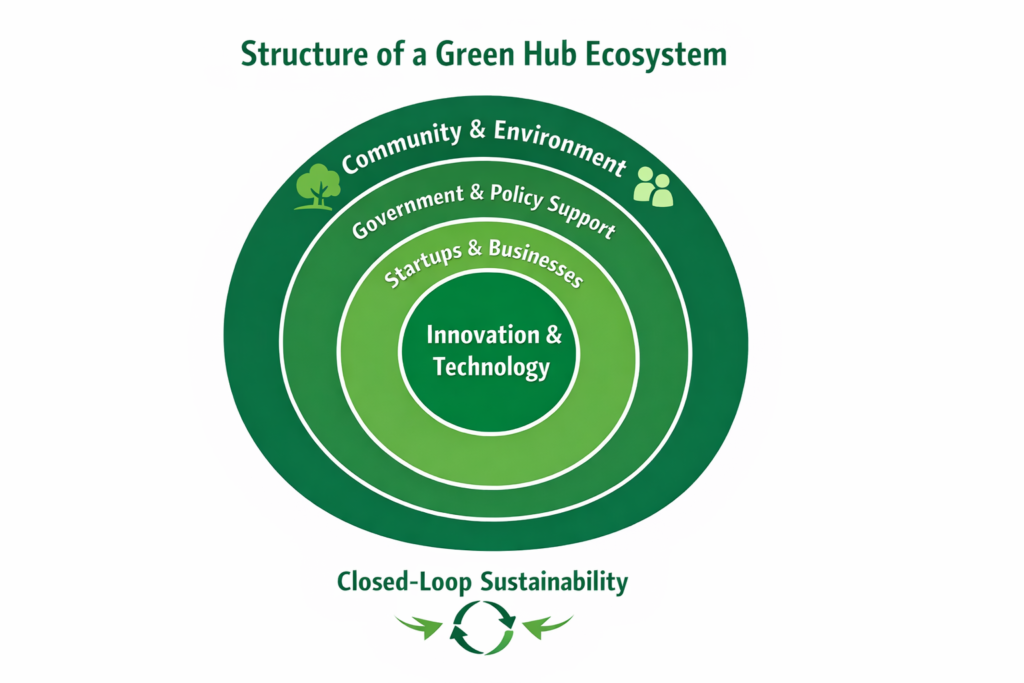
Figure 1: Structure of a Green Hub Ecosystem
Imagine a circular model where different elements interact:
- Center: Innovation & Technology
- Layer 1: Startups and Businesses
- Layer 2: Government & Policy Support
- Layer 3: Community & Environment
This circular design represents the closed-loop system. It is a key principle of sustainability where waste from one process becomes input for another.
Benefits of Green Hubs
1. Environmental Sustainability
Green hubs reduce carbon emissions. These hubs promote renewable energy and efficient resource use.
2. Economic Growth
They create jobs, attract investments, and support green entrepreneurship. They also contribute to economic diversification.
3. Social Development
By involving communities, green hubs enhance awareness and improve quality of life.
4. Technological Advancement
They accelerate the development and deployment of green technologies.
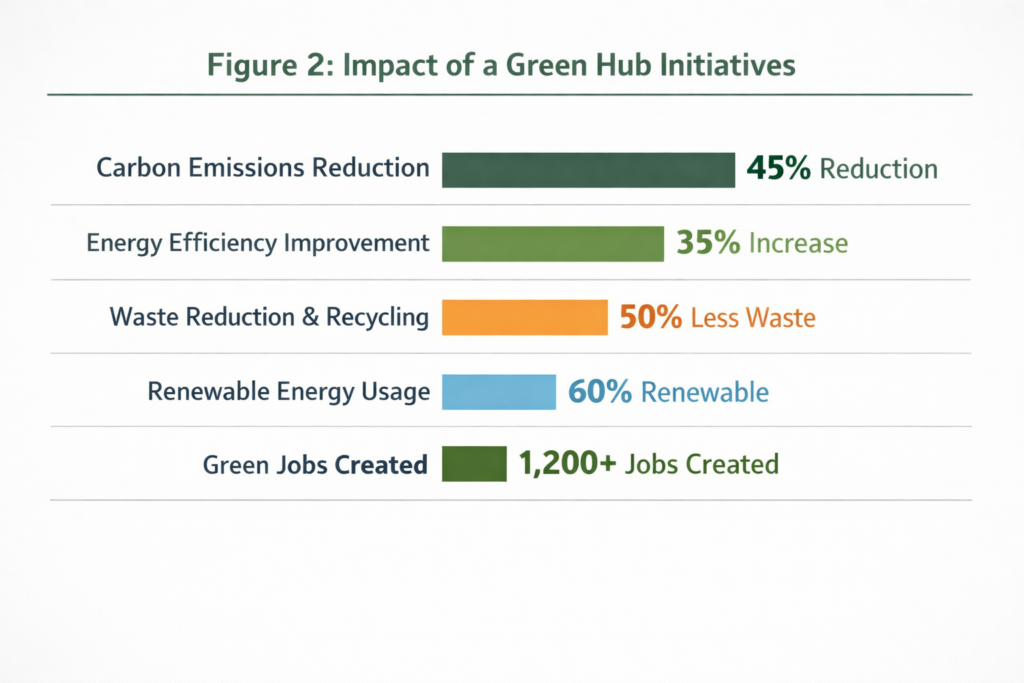
Figure 2: Impact of Green Hubs
A simple bar representation can illustrate the impact:
- Carbon Emissions Reduction: 40–60%
- Energy Efficiency Improvement: 30–50%
- Waste Reduction: 50–70%
- Job Creation Increase: 20–35%
These figures vary by region but highlight the transformative potential of green hubs.
Emerging Trends in Green Hubs (2026 and Beyond)
1. Integration of Artificial Intelligence
AI is increasingly being used to optimize energy consumption. AI has the potential to predict environmental risks, and manage smart grids within green hubs.
2. Circular Economy Models
Green hubs are shifting from linear production systems to circular models. In these models materials are reused, recycled, and regenerated.
3. Climate-Tech Startups
A new wave of startups focuses on climate solutions. They can be in carbon capture, green hydrogen, and sustainable materials forms.
4. Digital Green Hubs
Virtual platforms are emerging. They are emerging and taking active participation worldwide. They allow global collaboration without geographical limitations. These digital hubs connect researchers, investors, and policymakers worldwide.
5. Net-Zero Infrastructures
Green hubs are adopting net-zero strategies. Total greenhouse gases emissions are balanced by removal or offset are ensured.
Challenges Facing Green Hubs
Despite their potential, green hubs face several challenges:
- High initial investment costs
- Lack of skilled workforce in green technologies
- Policy inconsistencies
- Limited awareness in developing regions
These barriers require coordinated efforts from all stakeholders.
Green Hubs in Developing Regions
In countries like Pakistan, green hubs can play a crucial role in:
- Address energy shortages through solar and wind projects
- Promote sustainable agriculture practices
- Manage urban pollution and waste
- Supports youth entrepreneurship in green sectors
Local adaptation is key contributor in green hubs. It aligns with regional needs, resources, and socioeconomic conditions.
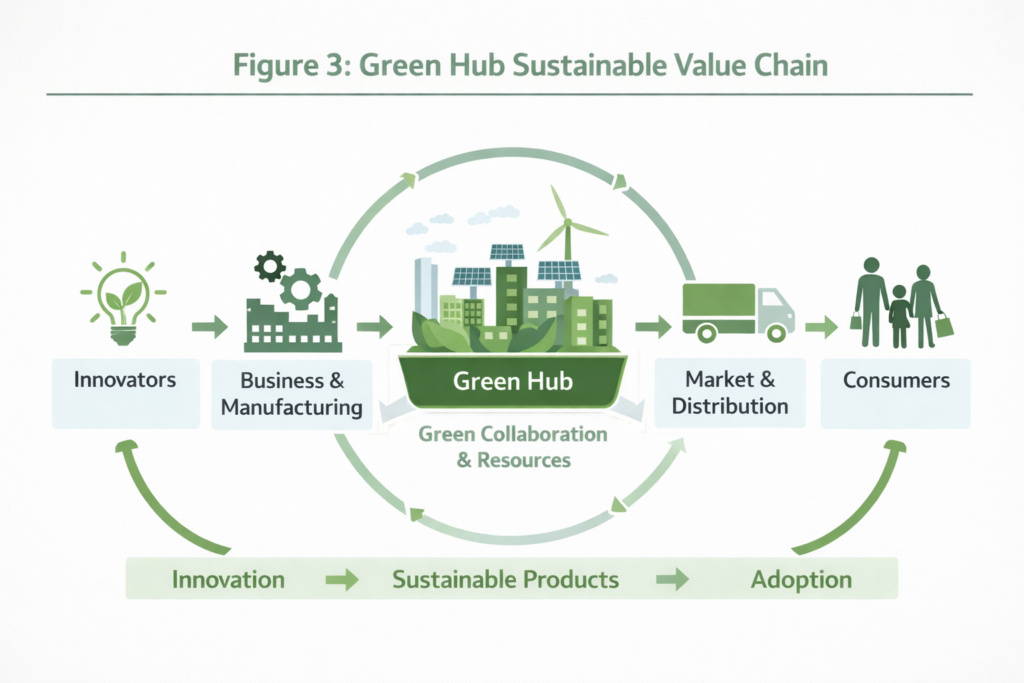
Figure 3: Green Hub Value Chain
A linear flow diagram can represent the value chain:
Input (Resources & Funding) → Innovation → Implementation → Impact (Environmental, Economic, Social)
This highlights how ideas are transformed into measurable outcomes.
Future Outlook
The importance of green hubs will continue to grow. In current era nations strive to meet sustainability targets and climate commitments. They are expected to become central to:
- Smart city development
- Renewable energy expansion
- Sustainable industrial transformation
Green hubs are not just an environmental solution but they are a comprehensive framework for sustainable development.
Conclusion
A green hub represents a powerful convergence of innovation. It justifies sustainability, and collaboration. By integrating technology, policy, and community engagement, these hubs offer practical solutions. They are potentially strong forum to some of the world’s most pressing environmental challenges.
As we move toward a greener future, the expansion and evolution of green hubs will be essential. Either in any form they are indespensible. Whether in urban centers or rural landscapes, they hold the potential to redefine how we produce, consume, and live. They ensure a balanced and sustainable world for future generations.
Leave a Reply